


Countdown
about
About SCECS 2027 | Nanjing, China
The 13th International Conference on Sensor-Cloud and Edge Computing System (SCECS 2027) is scheduled to take place on May 14-16, 2027 in Nanjing, China. The conference will primarily focus on the fields of sensor-cloud and edge computing system, providing an academic platform for experts, scholars, engineers, and professionals from various educational institutions, research organizations, enterprises, and establishments locally and abroad. This platform aims to facilitate the sharing of academic research findings, exploration of cutting-edge engineering issues, as well as discussions on current opportunities and challenges. Through this concerted effort to promote international cooperation and communication while advancing the industrialization of scientific research results.
We warmly welcome scholars both domestic and international to contribute their expertise and participate in the conference.
date
Important Dates
Supported by
Sponsor
 |
Organizer
 |
other
Topics
The topics of interest for submission include, but are not limited to:
Sensor Networks
Sensor Network Protocol Design
Data Fusion Algorithms
Real-time Data Processing
Low-power Sensor Technologies
Data Quality Assessment
Heterogeneous Sensor Networks
Sensor Node Localization
Self-organizing Sensor Networks
Data Encryption
Fault Tolerance in Sensor Networks
Simulation and Modeling of Sensor Networks
Mobile Sensor Networks
Data Compression
Machine Learning in Sensor Networks
Data Transfer Protocols
Data Privacy in Sensor Networks
Energy Management in Sensor Networks
Fault Detection and Recovery in Sensor Networks
Cross-domain Applications of Sensor Networks
Event Detection in Sensor Networks
Sensor cloud architecture
Sensor Cloud Architecture Design
Data Management in Sensor Cloud
Virtualization Techniques
Security Mechanisms in Sensor Cloud
Quality Management of Sensor Cloud Services
Integration of Sensor Cloud and Big Data Analytics
Data Sharing and Access Control
Development Framework for Sensor Cloud Applications
Elasticity and Scalability in Sensor Cloud
Automation Tools in Sensor Cloud
Real-time Monitoring in Sensor Cloud
Self-service of Sensor Cloud Services
Large-scale Data Processing
User Experience Design
Cross-domain Data Integration in Sensor Cloud
Multi-tenant Architecture
Migration and Sharing Mechanisms
Implementation of Machine Learning in Sensor Cloud
Case Studies of Sensor Cloud Applications
Collaborative Processing in Sensor Cloud
Data processing of sensor cloud
Real-time Analysis of Sensor Data
Historical Analysis of Sensor Data
Processing Large-scale Sensor Data
Data Visualization Techniques for Sensor Data
Data Mining Algorithms for Sensor Data
Machine Learning Applications in Sensor Data Analysis
Anomaly Detection Methods for Sensor Data
Cloud-based Analysis of Sensor Data
Predictive Modeling of Sensor Data
Clustering Analysis of Sensor Data
Sensor Data in Complex Event Processing
Sensor Data and User Behavior Analysis
Multidimensional Analysis of Sensor Data
Real-time Query Optimization of Sensor Data
Multisource Fusion Techniques for Sensor Data
Analysis and Processing of Sensor Data Streams
Semantic Analysis of Sensor Data
Security Analysis of Sensor Data
Sensor Data Analysis in IoT Environments
Case Studies of Typical Sensor Data Applications
Architecture and optimization of edge computing
Edge Computing Framework Design
Edge Computing Resource Management
Virtualization of Edge Nodes
Quality of Service in Edge Computing Services
Cooperation between Edge and Cloud Computing
Network Protocols for Edge Computing
Fault Management in Edge Devices
Load Balancing in Edge Computing
Dynamic Scheduling of Edge Computing Services
Data Caching in Edge Computing
Edge Intelligence and Machine Learning
Edge AI for Edge Computing
Edge Network Slicing
IoT Enabled by Edge Computing
Data Stream Processing
Application Development in Edge Computing Environments
Resource Scheduling Algorithms
Network Performance Optimization in Edge Computing
Latency Optimization in Edge Computing
Bandwidth Management Strategies
Intelligent algorithm of edge computing
Intelligent Perception Algorithms
Deep Learning Applications in Edge Environments
Adaptive Learning Techniques in Edge Computing
Data Mining in Edge Computing
Reinforcement Learning in Edge Computing
Integration Methods for Edge Intelligence Algorithms
Predictive Models for Edge Computing
Automated Decision-making in Edge Computing
Optimization Algorithms in Edge Computing
Feature Extraction in Edge Computing Scenarios
Image Processing Techniques in Edge Computing
Natural Language Processing in Edge Computing
Real-time Data Analysis in Edge Computing
Heterogeneous Intelligent Algorithms in Edge Computing
Edge Computing and Distributed Learning
Sensor Fusion in Edge Computing
Image Recognition in Edge Computing
Anomaly Detection in Edge Computing
Sentiment Analysis in Edge Computing
Multimodal Learning in Edge Computing
Security and Privacy Protection
Data Security Strategies in Edge Computing
Information Privacy Protection in Edge Computing Environments
Encryption Techniques for Sensor Data
Authentication Mechanisms in Edge Computing
Impact of Network Attacks on Edge Computing
Blockchain Applications in Edge Computing
Security Assessment of Sensor Cloud
Risk Management in Edge Computing Environments
Secure Communication for IoT Devices
Security Protocol Design in Edge Computing
Data Privacy and Compliance
Privacy-preserving Technologies in Edge Computing
Security Auditing in Edge Computing
AI Applications in Security Protection
Access Control in Edge Computing Environments
Privacy Leakage Analysis in Cloud and Edge Computing
Security Monitoring in Edge Computing
Trust Mechanisms between Sensors and Edge Devices
Defense Mechanism Design in Edge Computing
Risk Assessment and Management in Sensor Cloud
Index History
All accepted full papers will be published in the conference proceedings and will be submitted to Ei Compendex / Scopus for indexing.

Cover
SCECS 2026

Ei Compendex
SCECS 2026
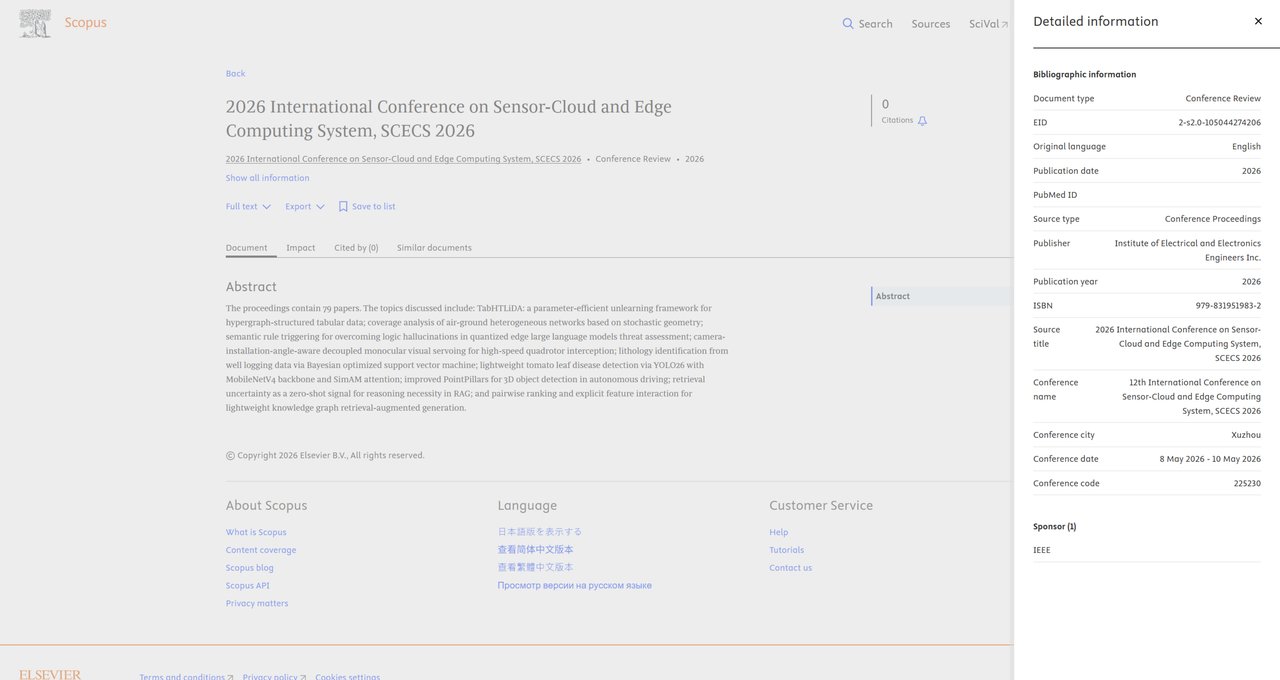
Scopus
SCECS 2026

Cover
SCECS 2025

Ei Compendex
SCECS 2025

Scopus
SCECS 2025
Note: All submitted articles should report original research results, experimental or theoretical, not previously published or under consideration for publication elsewhere. Articles submitted to the conference should meet these criteria. We firmly believe that ethical conduct is the most essential virtue of academics. Hence, any act of plagiarism or other misconduct is totally unacceptable and cannot be tolerated.
Contact Us

The Secretary office of SCECS will collect contributions and handle daily organizational tasks.
All paper reviews will be completed by Program Committee Members and invited experts.
* If you have any questions or inquiries, please feel free to contact us.